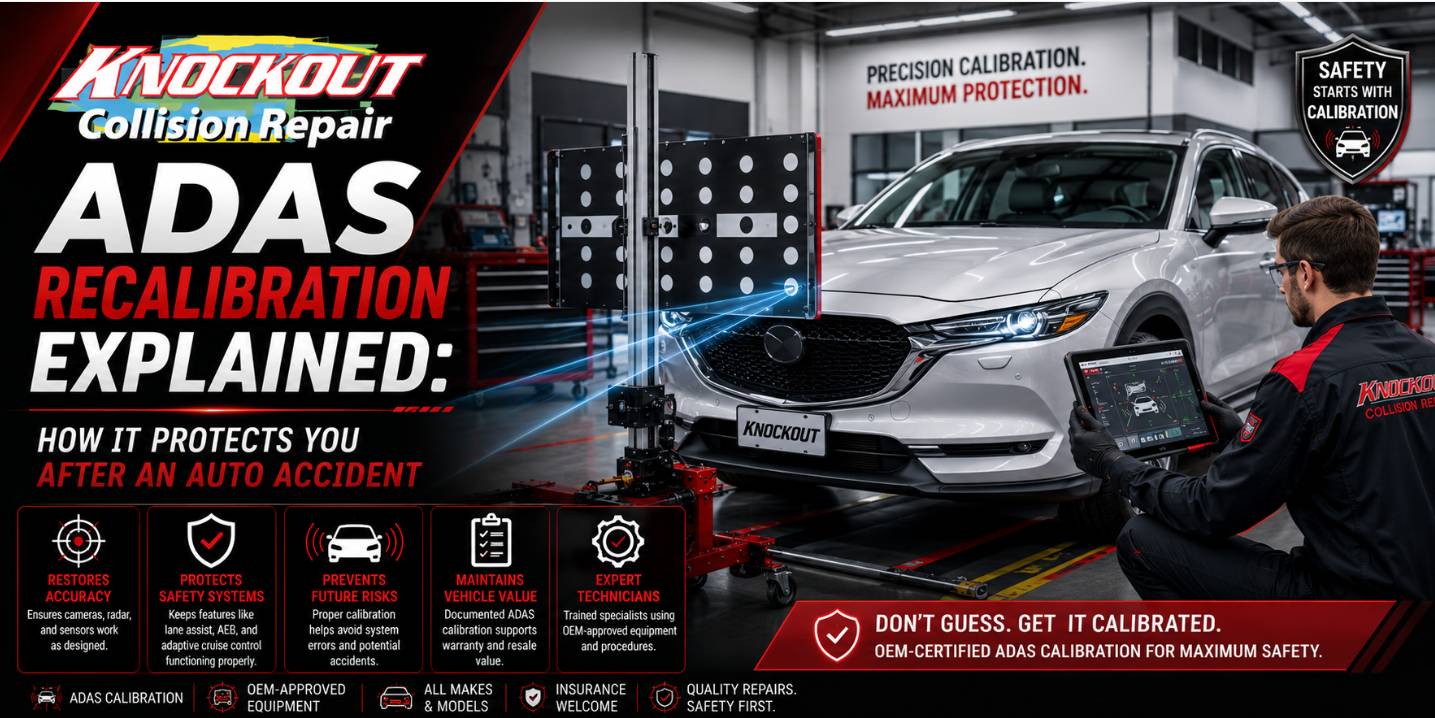
What protects you after a crash repair when the sheet metal looks right, but the safety tech behind the bumper no longer reads the road the same way? ADAS recalibration answers that question fast. Modern vehicles use cameras, radar units, sensors, and software to support braking, lane guidance, distance control, and blind spot alerts.
A small impact can disturb those reference points. Windshield work can change the camera position. Front-end repair can shift the radar aim. If you skip recalibration, your vehicle may still drive, but key safety features may not react with manufacturer-intended timing.
What ADAS Recalibration Means After a Collision
ADAS stands for Advanced Driver Assistance Systems. It covers lane departure warning, adaptive cruise control, forward collision warning, parking sensors, and blind spot monitoring. Recalibration restores the exact operating position of those systems after repairs change parts, geometry, or mounting points.
In repair terms, ADAS recalibration starts with one hard fact: these systems depend on precision. A camera can sit slightly off and still create major timing errors. A radar sensor can aim slightly high or low and misread the closing distance. Collision shops need to treat them as part of complete collision repair.
A proper process includes pre-repair scanning, structural measurement, alignment checks, post-repair scanning, and then vehicle sensor calibration.
How ADAS Recalibration Helps Restore Your Vehicle’s Safety Features
A finished repair should restore function, appearance, and safety together. Researchers reviewed 1,001 crashes involving ADAS-equipped vehicles and 548 crashes involving automated vehicles to examine how driver assistance technology affects safety outcomes. That scale shows how central these systems have become in modern repair decisions.
Keeps Cameras and Radar Systems Working as Intended
Cameras read lane lines, signs, and object position. Radar units measure distance and speed. Even a small shift in a bracket, bumper reinforcement, windshield mount, or front-end structure can change the angle those units use. That is why ADAS recalibration often begins with camera calibration and radar calibration, not cosmetic finish.
Technicians may use static calibration, dynamic calibration, or both. Static procedures rely on exact targets and measurements. Dynamic procedures verify performance during a road test under manufacturer rules.
Supports Accurate Lane and Braking Assistance
Lane support and automatic braking rely on clean inputs. If the camera misreads lane edges, steering assist can react late or track poorly. If radar data drifts, adaptive cruise control can misjudge space, and forward collision warning can trigger too late. These failures usually appear at speed.
This is why recalibration often follows alignment service, windshield replacement, suspension correction, and some structural repairs.
Helps Driver Assistance Features Respond Correctly
Driver assistance systems share data across modules. One front camera can support lane departure warning, sign recognition, and brake support. One radar unit can influence the following distance and crash alerts. When one input shifts, several outputs can drift.
At Knockout collision repair, we connect body repair, scan analysis, and calibration planning because a repair cannot stop at straight panels and new paint. The same AAA study found that ADAS-related parts accounted for 40.9% of repair costs in a typical minor rear collision, with an average cost of $684.63. That number shows how much modern vehicles depend on sensing hardware.
Reduces the Risk of Incorrect Sensor Readings
Incorrect readings create a hard post-repair problem because the vehicle can still look and feel normal. A blind spot alert may activate too soon. A parking sensor may react without reason. A braking alert may arrive late. ADAS recalibration explained also means knowing that a scan tool alone cannot confirm proper aiming. Scan tools reveal faults and communication status. They do not replace target setup or OEM road-test procedures.
Protects the Performance of Advanced Safety Technology
Advanced safety technology works only when the vehicle keeps the correct geometry. Ride height, wheel alignment, thrust angle, sensor mounting, and module communication all affect system performance. If one variable changes, the whole decision chain can shift. That is why advanced driver assistance systems need both mechanical accuracy and software verification after a crash.
We have served Chico drivers since 1999, and we follow manufacturer repair procedures whenever the vehicle requires them. That helps us handle domestic and luxury models with the same discipline, from structural correction to post-collision inspection.
Helps Meet Manufacturer Repair Requirements
Manufacturers publish repair instructions that tie specific repairs to specific calibration steps.
|
Repair event |
Why recalibration may follow |
Typical check |
|
Windshield replacement |
Camera position can change |
Camera calibration |
|
Front bumper repair |
Radar aim can shift |
Radar calibration |
|
Wheel alignment or suspension work |
Vehicle geometry changes |
Alignment and calibration review |
|
Structural repair |
Reference points can move |
Full scan and OEM-directed setup |
Why Vehicle Owners Choose Knockout Collision Repair for ADAS Recalibration Services
Vehicle owners look for a shop that restores safety, not just appearance. Knockout Collision Repair earns that trust through a process that connects diagnostics, structural work, finish quality, and communication from start to finish. The shop has served Chico since 1999, and that long track record shows in how the team handles modern vehicles with layered electronic systems.
- We use advanced scanning equipment, apply OEM-guided procedures when required, and perform camera, radar, and sensor recalibration alongside body and paint work.
- We handle frame straightening, structural repair, aluminum repair, precision paint matching, and insurance claim support, which keeps the repair path organized.
- We explain why a vehicle may need recalibration after alignment work, windshield replacement, or part replacement, so customers know what protects them and why.
That approach reflects a family-owned shop that treats collision repair as a safety job first.
When ADAS Recalibration Applies After Vehicle Repairs
Recalibration should happen when repair procedures, scan results, or manufacturer documentation call for it. That often includes bumper repair, windshield replacement, steering or suspension work, wheel alignment changes, sensor replacement, frame repair, and some module programming events.
Timing also matters. Technicians should complete structural and mechanical corrections first, confirm the final geometry, and then run calibration in the required sequence. If a shop calibrates too early, later repairs can undo the result. If it skips final verification, it can miss a new problem created during reassembly.
Conclusion
A vehicle should leave the shop with a straight structure, correct finish, and safety systems that read the road the way the manufacturer designed. That is the point of ADAS recalibration. If your car has gone through collision work, windshield replacement, alignment service, or sensor-related repairs, schedule a post-repair inspection and order the calibration the vehicle calls for before you return to normal driving.
Frequently Asked Questions
1. Can a small fender bender affect ADAS performance?
Yes. Minor impacts can shift brackets, sensor mounts, or alignment enough to affect system accuracy.
2. Do warning lights always appear when calibration is off?
No. Some systems stay active and still read the road incorrectly without showing an immediate warning.
3. Can windshield replacement trigger recalibration even without a crash?
Yes. Many vehicles mount front cameras near the windshield, so glass replacement can require recalibration.
4. Does insurance usually cover recalibration after an accident?
Coverage depends on the policy and repair scope, but insurers often include it when procedures require it.
5. How long does recalibration usually take?
Time varies by vehicle, repair type, and procedure.