When your car comes back from a body shop, how do you know it will protect you the same way in the next impact? That question should shape every repair decision you make. The OEM Parts vs Aftermarket Parts choice affects panel fit, sensor accuracy, crash energy management, resale value, and how the vehicle feels six months later. Price gets attention first, but a collision repair does far more than replace damaged metal and plastic.
It rebuilds the way your vehicle aligns, seals, scans, and performs on the road. If the part choice is wrong, the repair may look finished but still leave behind gaps, noise, calibration issues, or weaker long-term results.
OEM Parts vs Aftermarket Parts: What Sets Them Apart in Collision Repair
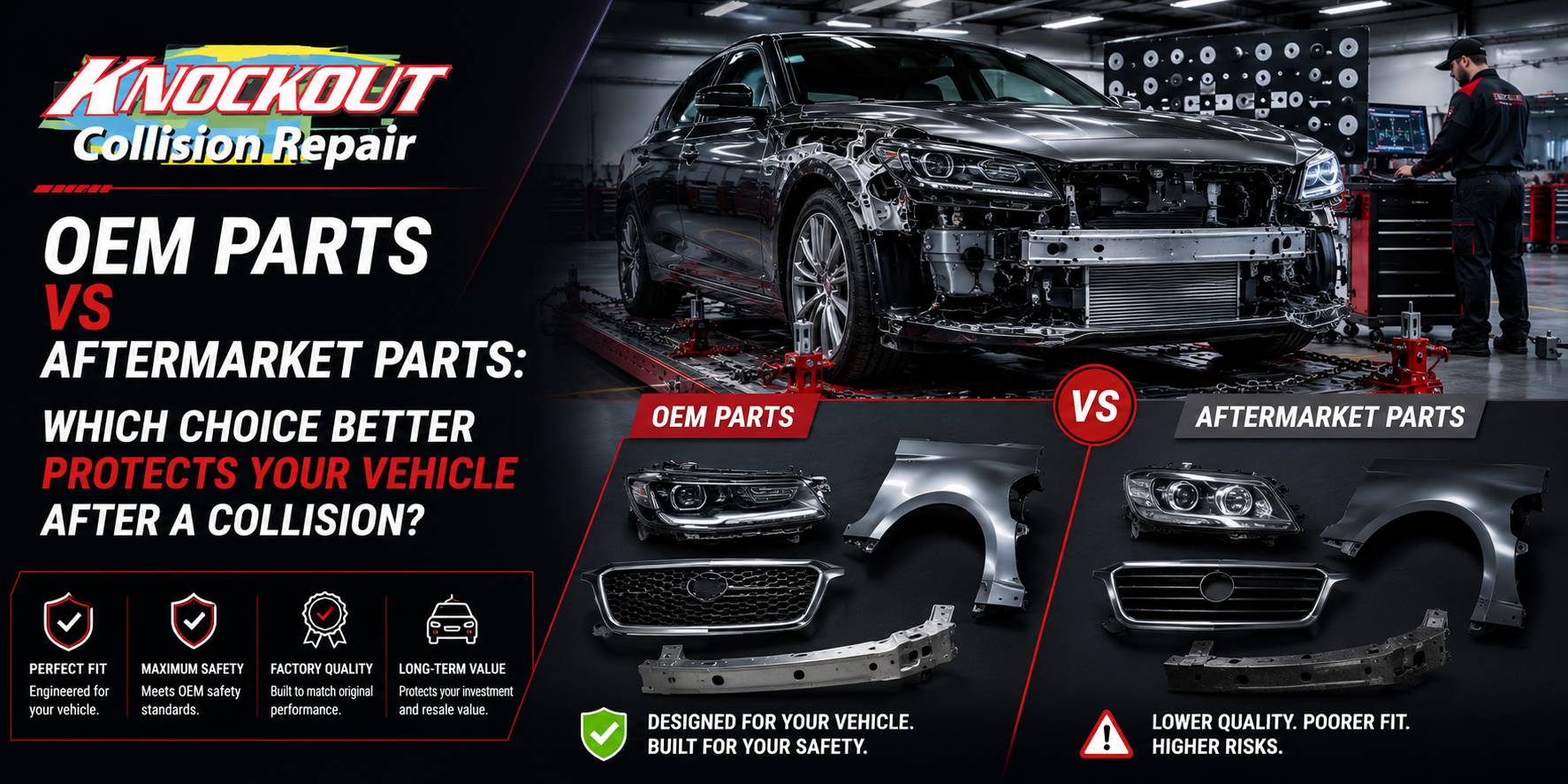
OEM parts come from the automaker or an approved source built to factory dimensions, material grades, and mounting points. Aftermarket parts come from third-party makers that design a replacement to fit the vehicle without following the exact factory production chain. Some are decent. Some are not. In collision work, that difference shows up fast because every bracket, edge, tab, and tolerance affects the final repair.
How OEM Parts Help Maintain Factory Fit and Structural Alignment
Factory parts reduce guesswork. Technicians can install them with fewer adjustments because hole placement, contour shape, and attachment points match the original design. That helps the shop restore body gaps, sealing surfaces, and structural relationships with less force and less improvisation.
In this repair discussion, fit is not a cosmetic detail. Fit supports proper assembly, quiet driving, and correct alignment across connected panels.
How Aftermarket Parts Influence Repair Costs and Insurance Decisions
Insurance estimates often favor the lowest acceptable line item, which is why aftermarket parts appear so often in repair negotiations. A U.S. Government Accountability Office report found that aftermarket crash parts can cost up to 65% less than OEM parts.
That price gap can shape insurer decisions, but a lower purchase cost does not always mean a lower total repair cost once adjustment time, finish issues, and refit work enter the job.
| Repair Factor | OEM Parts | Aftermarket Parts |
| Purchase price | Higher | Usually lower |
| Fit consistency | More predictable | Can vary |
| Labor time | Usually steadier | May increase |
| Insurer appeal | Lower in price | Higher in price |
| Finish result | More uniform | Depends on the maker |
When shops frame OEM Parts vs Aftermarket Parts only around estimated savings, owners miss what rework and fit correction can do to the full repair.
Impact of Part Choice on Vehicle Safety Systems and Sensors
Modern bumpers, grilles, brackets, and body panels now support radar units, cameras, parking sensors, and airbag timing inputs. That means part selection reaches into safety system performance. In the OEM Parts vs Aftermarket Parts debate, this is where technical risk gets serious.
A slight change in thickness, bracket angle, or mounting tension can affect calibration and system behavior. The vehicle may look perfect while electronic accuracy slips.
Role of Replacement Parts in Long-Term Vehicle Value
Repair records influence resale. Buyers, dealers, and appraisers pay attention to panel fit, paint match, documentation, and whether the repair followed manufacturer standards. A vehicle repaired with factory components and proper paperwork often raises fewer questions during trade-in or private sale.
That does not make every aftermarket part a bad part. It does mean the burden of proof gets heavier when someone inspects prior damage history later.
Repair Quality Differences That Affect Daily Driving Experience
Daily driving exposes repair quality faster than owners expect. A hood that needs extra pressure, a bumper edge that lifts, water noise near a door seal, or a headlamp that vibrates over rough pavement often traces back to poor fit or weak assembly accuracy. Good repair work should disappear into normal ownership. It should not keep reminding you that the vehicle was repaired.
Warranty, Compliance, and Manufacturer Standards After Repairs
On newer vehicles, repair quality also ties into scan reports, calibration records, corrosion protection, and manufacturer procedures for specific materials or assemblies. In that context, OEM Parts vs Aftermarket Parts becomes a documentation issue as much as a parts issue.
If a later problem appears, the repair should stand up to scrutiny. Owners should ask what part was installed, why it was selected, and whether the repair path matches automaker standards.
Why Knockout Collision Repair Focuses on OEM-Driven Collision Repair Solutions
Knockout Collision Repair fits this topic because the shop builds its repair philosophy around factory-led work, not shortcut-led estimating. Our team leans toward OEM parts whenever possible, follows manufacturer repair procedures, and focuses on restoring safety systems and structure, not just surface appearance. That creates a meaningful difference in a market where some shops let insurer cost pressure guide too many choices.
At Knockout Collision Repair, we begin with how the vehicle should be repaired, then we build the estimate around that standard. We also check structural measurements, diagnostics, and safety-system function so the finished vehicle does more than look repaired.
That approach shows up in several strengths:
- I-CAR Gold Class training and disciplined repair planning
- frame correction, diagnostics, lifetime warranty support, and claim guidance
The result feels practical, not promotional. A shop with OEM-first standards, non-DRP independence, and multi-brand repair experience can protect fit, crash performance, and long-term vehicle condition with more precision.
Choosing the Right Parts: OEM Parts vs Aftermarket Parts Before You Approve Repairs
Before you sign an estimate, ask for the exact source of every replacement part. Do not accept the word replacement by itself. Ask whether the estimate uses OEM, recycled OEM, certified aftermarket, or generic aftermarket components. Ask whether the damaged area affects ADAS calibration, suspension geometry, corrosion protection, or crash structure.
Request the repair procedure for your make and model. If an insurer pushes back, ask the shop where fit, safety, or long-term durability may change. A serious collision center should explain that in direct language. You are not asking for extras. You are asking what protects the vehicle best after a major hit.
Conclusion
A strong repair brings back safety, fit, value, and road feel, not just appearance. The smartest way to judge OEM Parts vs Aftermarket Parts is to look past the first estimate and ask how the choice affects structure, sensors, warranty position, and resale later, for years ahead. When you want post-collision repairs built around factory-level protection, contact Knockout Collision Repair and let us form the right repair plan for your vehicle.
FAQs
Are OEM parts always required after an accident?
No. Policy terms, vehicle age, state rules, and repair justification usually decide that.
Do certified aftermarket parts fit just like factory parts?
Not always. Certification helps, but fit, finish, and consistency can still vary.
Can wrong parts affect blind spot or parking sensor performance?
Yes. Mounting position and material differences can interfere with calibration and readings.
Should I accept recycled OEM parts for collision repair?
Sometimes yes. They can work well when the conditions, source, and compatibility are verified.
What should I ask for before approving a repair estimate?
Ask for part source, repair procedure, scan plan, calibration needs, and warranty details.